Thursday, February 21, 2013

Building My Bike: #5 Bottom Bracket, Crankset and Cassette

I had hoped to move the drivetrain from my old bicycle to the new frame and I did, for the most part. Taking the crankset off was straightforward. I had never taken a cassette off a wheel, so that was new but wasn't too hard. A helpful tip: cassettes come off one cog-at-a-time (for the most part) and there are spacers between some of them so take pictures of the pieces that come off in the order that you took them off. It will really help you putting things back together.

When it came time to remove the bottom bracket, I found I had two problems. First, I had the wrong tool because I thought I had a BB with external cups. Yeah, that's a stupid thing to not notice but, in my defense, my old bike originally came with one but that changed when I switched to a compact crankset, so I'm not completely hallucinatory. The second problem was that when I turned the bottom bracket, it felt a bit rough so I figured it needed replacing. I decided to let get a new bottom bracket and at the LBS and let them install it. I'm not convinced that was the most cost-effective decision but I didn't want to buy yet another tool and was anxious to get this done. Oh well, they put it on and it is smooth as silk.

Putting the crankset on the new bike was, of course, a piece of cake.
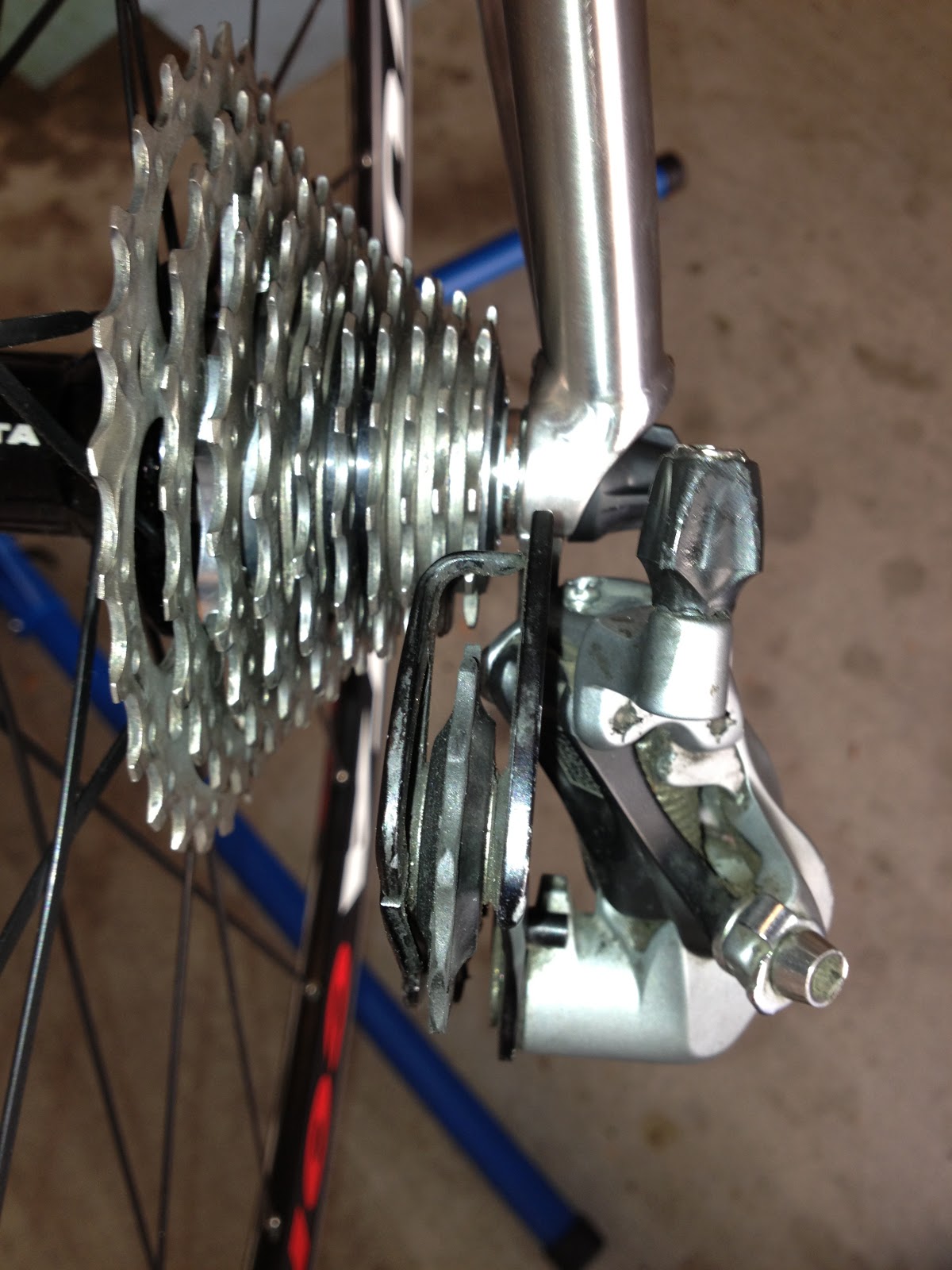
Before I put the cassette on the new wheel, I wanted to clean it. All I did was mix up some water with degreaser and soak the cogs in there while I did other work on the bike. After an hour or two I took them out, wiped them off with a shop towel, and put them on the rear hub. While they don't exactly look new, it is a huge improvement over how they looked before.

Oh, and while I was down there, I added the bottom bracket cable guide. That's something you don't usually think about, do you? Not only does your LBS probably not stock them, they are kind of a neglected part out there on the internet. Your best bet is to find them on eBay. The problem is that there are different sizes of cable guides because of the different sizes of bottom brackets and you don't always get a description of the BB size for your cable guide. The guide from my old bike didn't fit so, originally, I bought a Campagnolo cable guide on eBay because I thought it would be funny ("Find the Campy part I used."). It turns out that it was made for a bigger BB so I couldn't use it, either (though I did try and ended up stripping the cheap screw in the process--I had to break the cable guide and used pliers to remove the screw). Stopped at the LBS, they had a couple different types laying around so I got both. The ugly one fit best. Oh well, nobody will see it but me.

Update 3/2/13: Competitive Cyclist just posted a gallery of their new Merlin Extralight titanium bike. Look at the bottom bracket cable guide! Looks like I'm in good company.

Tuesday, February 19, 2013

Building My Bike: #4 Headset and Fork

The headset. It doesn't do so much. It connects the fork's steerer tube to the head tube, allowing you to steer the bike. And that's it. So how do you decide what headset to get? I don't have much experience with them but the overwhelming consensus on the internet is that Chris King makes the best headsets. They work well and they last. Sounds good. Headsets don't cost all that much, relatively speaking, and, while a Chris King Nothreadset costs over $100, which is twice what a lower-end headset costs, it's still not the most expensive one out there. A pro-level component for not much over $100? Sold.

I thought getting a fork was going to be much simpler than what it turned out to be. That's because I didn't know as much about forks as I do now. Specifically: fork geometry. See, I thought I could just buy any old carbon fork and it would be good. So I went to Bike Island, which stocks components found on BikesDirect.com bikes, and looked at forks. Something I noticed was this thing called "rake". It differed between different forks. Hmmm. So I did some reading on the internet about forks, which lead to another term: "trail". Good thing I did. Because of my frame's head tube angle, the rake found on most forks would not give me the right amount of trail. That article said a trail of 57mm is ideal but that is what my last bike had and I could not ride hands-free for very long so I wanted a bit more trail. I used this handy trail calculator and found that I needed a fork with a rake of between 48 and 50mm to get the trail I wanted (time will tell if it makes much difference). Finding a fork with a trail like that was not much of a problem. For instance, both 3T and ENVE make forks like that. Finding a fork with a trail like that that wasn't over $400 proved to be more of a test. I finally found an online store that had a 3T Funda Pro fork with a 49mm rake (which made my trail 60mm) at a good price. Sold.

Fork (with crown race), headset, and frame. All I needed to do was put them together. It turns out that assembling all that requires specialized tools that is just not worth me purchasing. I dropped everything off at the LBS and the job was done the next day. If you get a headset installed on your frame, check out its orientation. If the headset's logo is aligned (e.g. the logo faces forward), your shop is paying attention to details (mine did). That's a good thing.

Sunday, January 27, 2013

Building My Bike: #3 The Frame

I talked a little bit about ordering my frame in a previous post but things didn't turn out quite as planned so I'm going to write about the process of getting a custom frame and a little about the frame itself.

Based on my fit, we decided to go with a completely custom frame. I went to a dealer for Carver Bikes to order a custom titanium frame. Went went through the list of options and, since I am working with a limited budget, only chose a couple of them. I put down my deposit and they sent the order in. The frame was to be delivered around October or November. Great!

Some time had gone by and it turns out the order wasn't progressing. Why? Well, when you order a custom frame, the frame builder needs some dimensions...like all of them. How did the bike shop not know this? I went back and forth with the shop a few times but they would tell me one thing, somebody else would tell me another, and then I wouldn't hear from the shop. I took matters into my own hands and called Carver directly, speaking with Davis Carver himself. He was very helpful and told me exactly what I needed: basically, the geometry of a bike that would likely fit and we could use that as a starting point. I asked Jim from FinalFit what bike that would be and he told me that the Trek Domane, with a slightly different seat angle, would be that bike. I sent the geometry of the Domane to Davis, told him about the seat angle, and we were off.

He came back with a very detailed blueprint for a proposed frame. Now I saw why he needed the geometry. Length of tubes and stays, various angles. I have pretty much only ridden my old bike so I don't have experience with how these different measurements affect my ride so it was great that Jim could suggest the Domane. Given that it's made for Fabian Cancellara to ride in Paris-Roubaix, I am optimistic that it will be a comfy frame.

The blueprint showed that the seat angle was making the wheelbase too short so I changed the seat angle from my ideal of 71 degrees to 72 (Jim said we could still work with that) and lengthened the top tube by 1cm. Carver sent me a revised blueprint and I studied that for a while. I was having problems getting a response from Jim but, in all fairness to him, he was getting ready to move his business (again) and launch a new one so I understood. While I was debating whether to change the blueprint, Davis sent me an email...with pictures. The frame from the last blueprint was actually made by the guys in Taiwan! I asked Davis how much it was, since it wasn't quite right (wrong finish, maybe one more tweak to go (maybe)). He knocked a few hundred off. Sold! What to do about the bike shop, though?

During all this time, the bike shop had been not helpful. Not preventing anything but not helping me out. At all. I would get one story from Jim and Davis, and another from the bike shop. Interesting thing: Davis told me that, though the shop is listed as a dealer, they have never ordered a frame from him. However, the shop owner said that the last frame they ordered from Carver was several months ago. Hmm. Davis always treated me really well and the bike shop didn't so I am going to have to go with Davis on this. So, now that we had a frame and a discount price, how do we make that transaction happen? By cutting the bike shop out of the deal. They didn't earn whatever they were going to make, IMO, so I had no problem with that. I called the shop and, after a few back and forths, including a heads up to Davis that they were going to call him, the order was cancelled. Once I got my deposit back, I paid Carver Bikes and my frame was on its way. It arrived and has been sitting in my bike stand ever since, waiting to be assembled.

So what should you do if you're thinking about getting a custom frame and don't have much money? I mean, you could go first class with a more traditional frame builder but I don't have nearly that kind of money so that was right out. Based on my experience, here is what I would suggest:

  • Get a bike fit with a fitter who can recommend base frames for you based on that fit.
  • Discuss with your fitter what changes, if any, you should make to your base frame's geometry.
  • Learn about fork rake and trail.
  • Use a trail calculator to determine what fork rake you will need on your frame to get the trail you want. You may have to adjust your head tube angle as a result.

In my case, I learned about fork rake and trail after I had the frame. I will write about that a bit more when we get to the fork and headset. One thing I would have liked to have changed on the frame is the finish. I wanted a bead blast finish and the Carver logo in brushed finish. The frame is brushed finish and a sticker logo. I'll live. Another thing that might have been nice is a tapered head tube but that is just a hunch since I don't have any experience with them.

I have placed my order for the last part (the fork) so I will be posting about the assembly process soon.

Saturday, December 15, 2012

Building My Bike: #2 The Plan

Oh my goodness, I am learning so much about bikes and I haven't even started yet. Headsets and fork rake and steerers and bottom bracket cable guides and anti-seize compound. Wow.

So, what's the plan? Here is what I need to tackle, in (planned) order:

  1. Fork and Headset
  2. Stem & Handlebar
  3. Bottom bracket
  4. Crankset & pedals
  5. Cassette & wheels
  6. Brakes
  7. Derailleurs
  8. Chain
  9. Shifters
  10. Front shifter cable
  11. Front brake cable
  12. Rear shifter cable
  13. Rear brake cable
  14. Saddle
  15. Bar tape

I don't have all the tools or parts yet. Here is my shopping list:

  • Fork
  • Wheels
  • Bottom bracket tool
  • Lube
  • Anti-seize compound
  • Cassette Lockring Tool
  • Need-nosed pliers
  • Wire cutters
  • Electrical tape
  • Chain whip
  • Spacers?
  • Bottom bracket cable guide

There are three things that I won't have the tools for. One is installing the headset cups. Next is facing the head tube. The last is cutting the steerer tube (not complicated but I'm not going to buy a saw just for that).

I wish I could get everything at once and attack the job in a weekend but, alas, I can't. On the other hand, I'll have time to blog about each phase. :-)

Thursday, December 6, 2012

Building My Bike: #1 The Decision

The plan was simple: order a frame. Pay a bike shop to transfer everything except the wheels and cables from the old bike to the new frame. Done. "New" bike.

Except it isn't quite that simple. I was pretty sure I was going to have to buy a new fork, since the new headtube is longer than the old. Okay, so buy a new fork from Bike Island and headset from whereever and also give those to the bike shop.

Then the frame finally arrived. I unpacked it, held it up, and looked at it. Wow, it sure is just a frame. Doesn't even have the plastic cable guide thing under the bottom bracket.

Then I'm afraid I started thinking (a dangerous pastime, I know). A few months ago, Flo Cycling posted a ebook called "How to Build a Road Bike", which I downloaded. Could I put this bike together myself? I'm not the handy-est guy in the world but I do okay with my bike. I have a stand and can give my ride a rudimentary tune-up. What's the worst that could happen? My bike comes apart as I'm flying down a hill at 50 mph. Yikes! Best not think about that one too much. Okay, what's the next worse that could happen? I make a mess of things and have to take everything in a box to my LBS and have them put the bike together. What's the best that could happen? I learn a heck of a lot about my bicycle (and bikes in general), get some new skills (and tools), and I would be able to point to the bike and say, "I put that together."

The benefits are too much to resist so I have decided to put my bike together. What am I most nervous about? Bar tape. I could never get that right when I was a kid. However, these days I am armed with the Flo book, my bike repair book, and the collective wisdom and videos of the internet.

This isn't something that is going to happen overnight. I need a few more tools, the aforementioned fork, wheels, and...I think that's it. I'll document each project as I go, thinking that maybe it will help somebody else do the same thing. I'll also document why I chose this part instead of another one. This is bike building while trying to keep the budget down. If money wasn't an object, I wouldn't bother building it myself, you know?

Saturday, September 22, 2012

Michaelade

One of the bummers of not riding since my accident in May is that I was really getting my bike nutrition down. Last year I started experimenting with a recipe for my own drink to take on long bike rides and this year I started making my own "bars" to eat. While the bars still need some work, now is as good a time as any to share the drink recipe:

Mix together with water in a 24 oz. water bottle.

The story behind the recipe:

A couple of years ago I was listening to a podcast on Competitor Radio with Asker Jeukendrop, a sports nutrition scientist. On the show, he talked about how glucose and fructose have different pathways to get absorbed by your body, so by consuming both (in about a 2-1 ratio--it's around 9:00 into the podcast) you would increase the amount of carbohydrates you can absorb compared to consuming either by itself. Makes sense. He also gave an amount of carbohydrates that people can typically absorb so I did some mental calculations (drinking every 15 minutes on the bike, typical amount per drink, 22 oz water bottle, composition of sucrose (table sugar), taking in other food, etc.) and came up with 2 Tablespoons each of table sugar and dextrose. That didn't sit so well in my stomach on long, hard rides, though, so I dropped down to 1½ Tablespoons each and that worked much better.

What to do for electrolytes? I looked and looked but there aren't a lot of choices for electrolytes on their own. There are things like Nunn tablets, which act like Alka-Seltzer when you drop them in water. Unfortunately, they tasted like Alka-Seltzer, too. I found Elete Electrolytes, a liquid that I could add to my drink but that wouldn't be so convenient to take along on long rides when it came time to refill my bottles. I used to crack open an Endurolyte capsule and put its contents in my bottle but it doesn't dissolve in water so well. I finally settled on the Base Performance Electrolyte Salt (even though I have a sneaking suspicion that it is just re-packaged Real Salt). Each container comes with a tiny measuring spoon and I scoop one of those in my water bottle. I tried using two spoonfuls but it was way too salty.

As for the Kool-Aid, I needed to put some flavor in the drink. Sure, I could go with something all natural but, frankly, I can get three servings out of a 20-cent package of Kool-Aid and there are a lot of flavors to choose from. I really don't think that it's going to kill me.

Why come up with my own drink? Why not just buy a bucket of stuff they sell in bike shops? For one thing, I don't want to spend a bunch of money if I don't have to. What do I need this drink to do? Hydrate, replace electrolytes, and supply as many carbs as I can handle. Do I, a 49-year old, middle-of-the-pack triathlete, really need so-called cutting-edge nutrition? Or do I need some water, sugar, electrolytes, and flavor? I'll go with Door #2, if I can.

A side note: I am training with Gatorade on the run. Why Gatorade and not Michaelade on the run? Because on the bike I have four water bottle cages that let me carry whatever I want. I can also put some drink mix in ziploc bags (which I can stash in a jersey pocket) to make more when I finish the bottles. I can drink higher-calorie drinks on the bike than I can on the run because of the pounding one's body takes on the run. On the run, even if I take a FuelBelt with me, that will only last eight miles in the heat. During an iron-distance triathlon, I have to live off the course for drinks, though I plan on taking some gels with me. Gatorade lets me do that and it's what they have on the Vineman course.

How does Michaelade compare to store-bought mixes? First, you have to remember that I don't know what I'm doing. Given that, though, I like the drink. It doesn't upset my stomach, and it, combined with other foods (Snickers, e-Gels, and the aforementioned homemade bars) works for me on my rides. YMMV. Let's compare it to Hammer Nutrition's HEED and Perpetuem, and Skratch Labs' Exercise Hydration Mix:

  Michaelade HEED Perpetuem Skratch EHD
Cost per 24 oz. bottle $0.38 $0.66 $1.50 $0.98
Calories per Serving 139 100 270 80
Sodium per Serving 290mg 40mg 220mg 310mg
# of Flavors 11 4 3 4

What does all that prove about Michaelade? Well, the cost is cheaper, calories are okay, sodium is good, and a lot more flavors, for starters. The point of all this is that my homemade, relatively cheap sports drink is working for me. Will it work for you? Don't know. You could give it a try, make some adjustments, and see what happens. Or not. Remember, this is not cutting-edge research. It's just me trying to save some money in my triathlon hobby and if I can, you probably can, too.

Wednesday, September 5, 2012

The Year Ahead

So much for 2012.

Accident in May. No running for two months. No bike 'til possibly November. Yeah, my 2012 triathlon season was a bust. Time to focus on 2013 and that focus can be summed up in one word: Vineman. All my training between now and next July is in preparation for the Full Vineman Triathlon (an iron-distance event).

Why Vineman? I have a friend from way back whose first stab at an Ironman didn't work out so well so she's going to attempt the distance again at next year's Vineman. When I saw that, I figured "Why not?". It's a full iron-distance event (2.4 mile swim, 112 bike, 26.2 mile run), the swim is done in a river (I can't do ocean swims), though the race will be in July the Northern California weather should be manageable, and the price is less than a WTC-affiliated event. It'll be nice to have someone I know in such a big race.

So what does that mean training- and racing-wise? For starters, it means I'm not going to have the time to do a half-iron-distance race beforehand. There's just no room in the calendar for it, especially since I can't do ocean swims. Does that worry me? No, I know I can finish a 70.3. When I've had some pool time, swimming 1.2 miles isn't a problem. Riding 56 miles isn't a problem, either. And I've done four half-marathons. I'm familiar with all the legs and it would be just a matter of finishing.

I want to do a marathon beforehand. I want to know what running 26.2 miles feels like so I can (somewhat) prepare for that during a triathlon. Which one to choose, though? I'd love to run a big one like the L.A. Marathon. However, the logistics of getting to Dodger Stadium for the start, then getting back from Santa Monica at the end doesn't make me happy. There is a little group, Rocket Racing Productions, that puts on small, low-key marathons (yes, plural) by the ocean in Santa Monica, that has piqued my interest. Fully supported. Experienced organizers. Start and end in the same place. Don't have to weave around 20,000 walkers. Did I also mention cheap ($49 for a marathon!)? They put on multiple races a month throughout the year. Wow! I'm aiming for one in February (they don't have their 2013 calendar up yet).

Since the bike course is easy (only 2200 feet of climbing), I don't have to hit the hills so hard. That and no track cycling means my thighs aren't going to get huge. It turns out that the little bit of track cycling I did and the tough climbing I was doing on the bike conspired to put some good muscle on my legs. I didn't know 49-year olds could put muscle on that easily but I did. There's another reason to hold off on track cycling: bike fit. From the first session, I started having IT Band Syndrome. The next session made it worse. By the time of my accident it was getting better because I hadn't been on the track in a few weeks. The pain from the accident on my left side covered up the IT band pain on my right side. The IT band problem was likely due to poor bike fit, caused by my renting a bike because I don't have a track bike. If I leave track cycling for after Vineman, I won't have to deal with the extra weight from bigger legs. If I go back to the track, though, it's going to have to be on a bike I bought so it will fit properly. I'm thinking my bike training can be summed up on one word: long.

I don't want to swim year-round (I still suffer burnout from competitive swimming in my youth) but I do want to be in good shape for Vineman so I'm not wiped out before getting on the bike. I know I can get in okay shape in a month, so I figure four months of training should do. That means I'll start swimming in April but that also means that I can't do the IronBruin next March.

Maybe I'll do a sprint triathlon in May or June but that's just an idea I'm tossing around in my head. I don't think I should do the Santa to the Sea half-marathon this December, so that will have to wait until 2013. Oh, and I need to do a 5k race in October (and another in March) to gauge how I will be training for the marathon (per Run Less, Run Faster).

Right now I am running three or four days per week. A long run of no more than nine miles on Saturday, then some 5.5 mile runs on Sunday, and Tuesday and Thursday mornings. I have been running in the heat on weekends. During the race I will be starting my marathon in the afternoon so I want my body and mind to know what it's like to run in the heat. How much to drink. When to slow down. When to walk. I finally did a sweat test this past weekend and found that I sweat a half-gallon in an hour in moderate heat. Time to start testing drinking more on the run.

So, the plan in a nutshell: Vineman in July. Marathon in February. Swim starting in April. Long-distance training on the bike (once it gets here in November). Stay healthy. Oh, and it would be nice if I could lose some weight.